Auralytics: Your fascinating music stats for Spotify
Overview
Auralytics explores how data can deepen human self-understanding through music.
In an age where streaming platforms algorithmically define taste, Auralytics reclaims personal data as a medium for reflection rather than prediction. The system transforms Spotify listening histories into interactive narratives that reveal how identity evolves through sound, showing how moods, memories, and cultural moments are encoded in everyday listening patterns.
Built as an open-source experiment in data-driven introspection, Auralytics invites users to engage with their own musical footprint across time and emotion. It proposes that analytics need not only optimize behavior but can instead illuminate the subtleties of who we are becoming.
At its core, Auralytics asks a simple question with profound implications:
When machines learn from our choices, can we also learn from the traces we leave behind?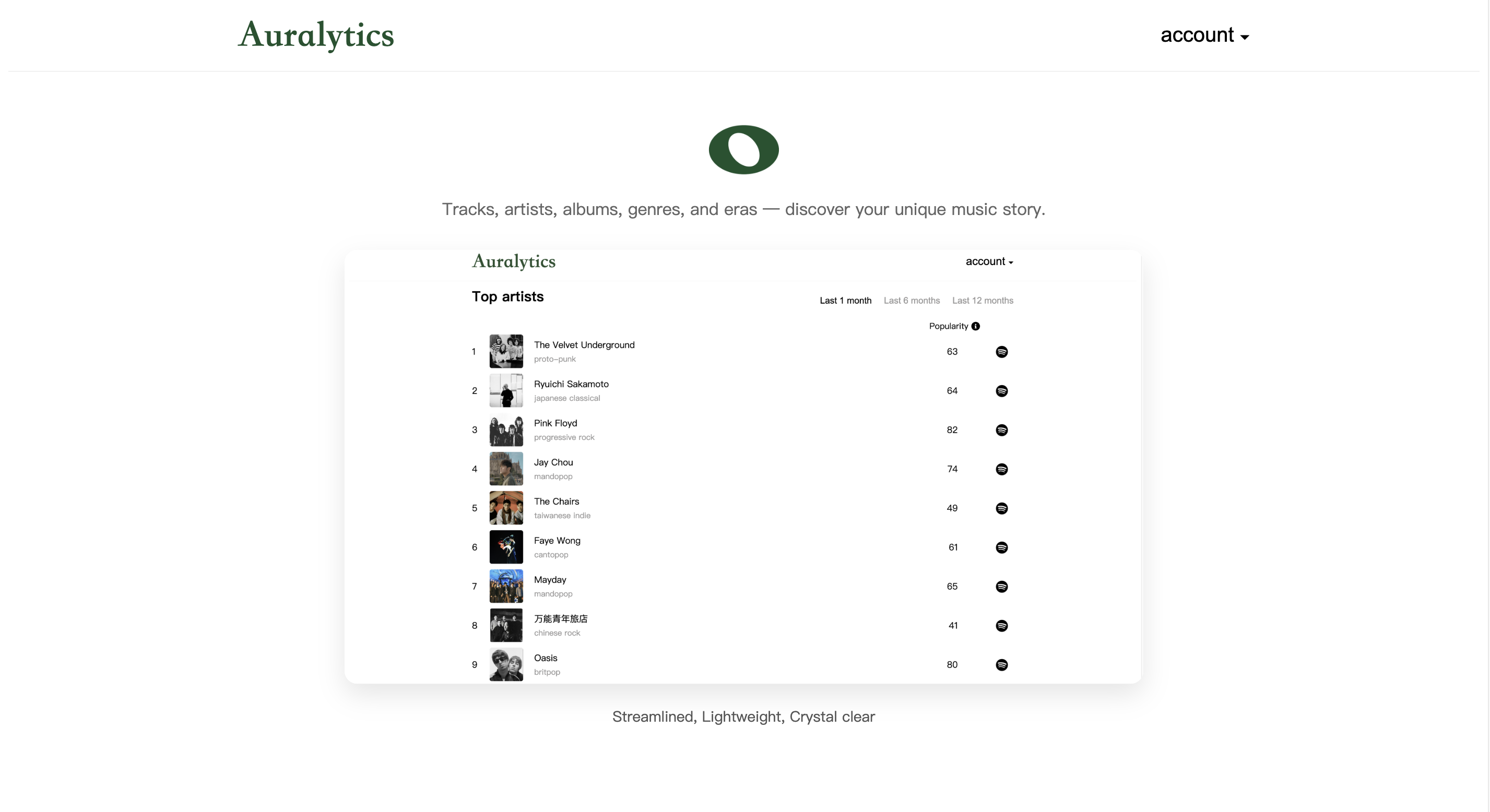
Design
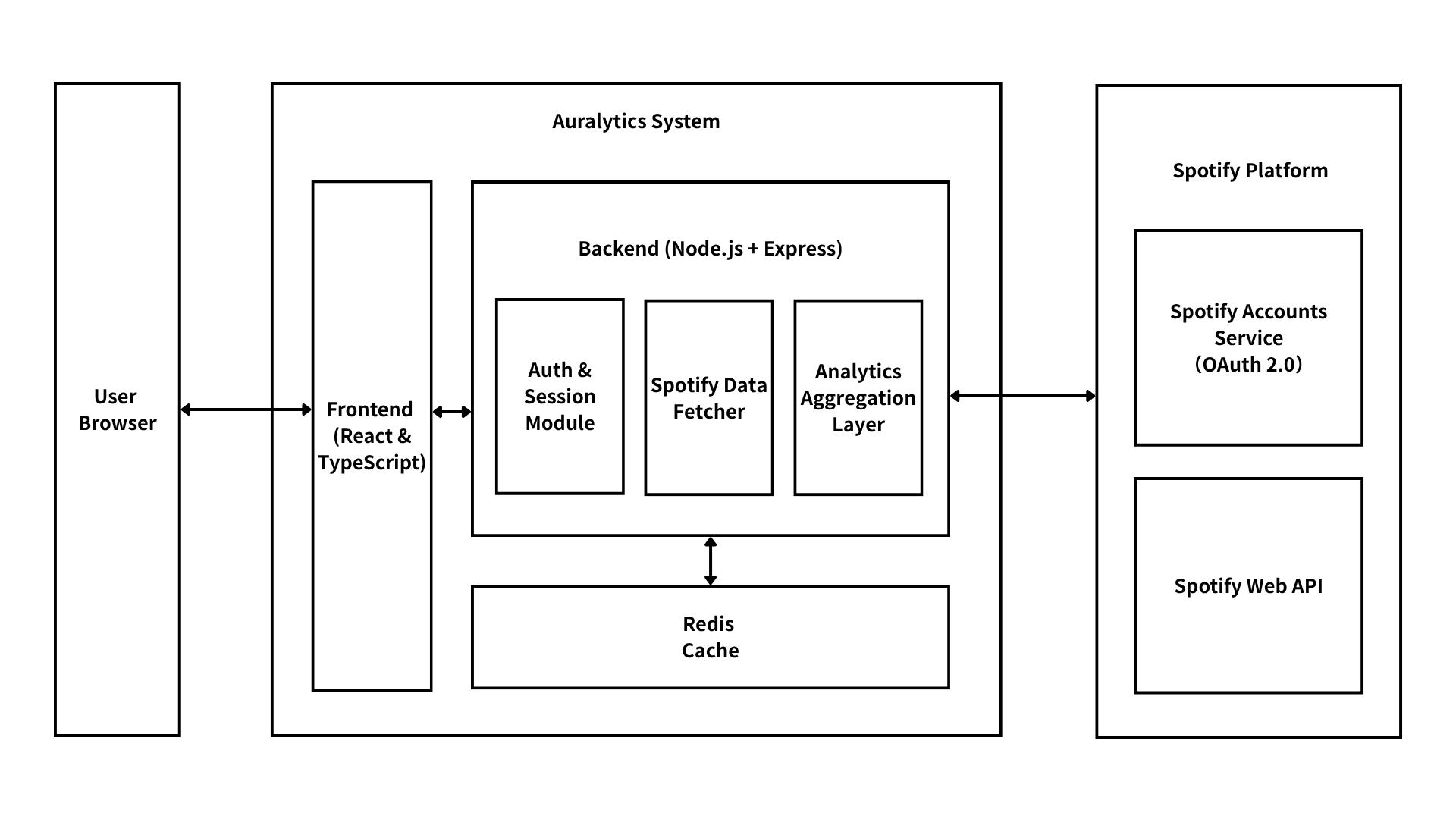
Rather than presenting data as static metrics, the interface treats each user’s listening history as a living texture, one that shifts fluidly across time. Every visualization, from genre constellations to temporal trend lines, is built to evoke curiosity rather than to quantify identity.
A lightweight full-stack framework integrates a React + TypeScript frontend with a Express + Node.js backend and a Redis caching layer. This structure enables real-time responsiveness while minimizing redundant API calls to Spotify, allowing the system to process more than sixty-six thousand tracks concurrently.
Through an internationalization (i18n) layer, Auralytics natively supports ten languages, ensuring that users across cultures can interpret their music data in their own linguistic and emotional context. Authentication is handled through Spotify OAuth 2.0, maintaining privacy while enabling seamless access to personal listening data.
Features
Auralytics turns passive listening into an active dialogue with data. Users can explore their top tracks, artists, albums, genres, and eras across the past one, six, and twelve months, revealing how musical preferences evolve over time. The platform translates raw streaming histories into clear visual forms, allowing listeners to trace seasonal shifts, rediscover forgotten songs, and uncover hidden affinities among artists.
Each analytical view is designed to feel personal rather than statistical. Genre distributions unfold like palettes of mood. Temporal charts move with the rhythm of listening cycles. These elements invite the user to interpret patterns through intuition, transforming analysis into reflection.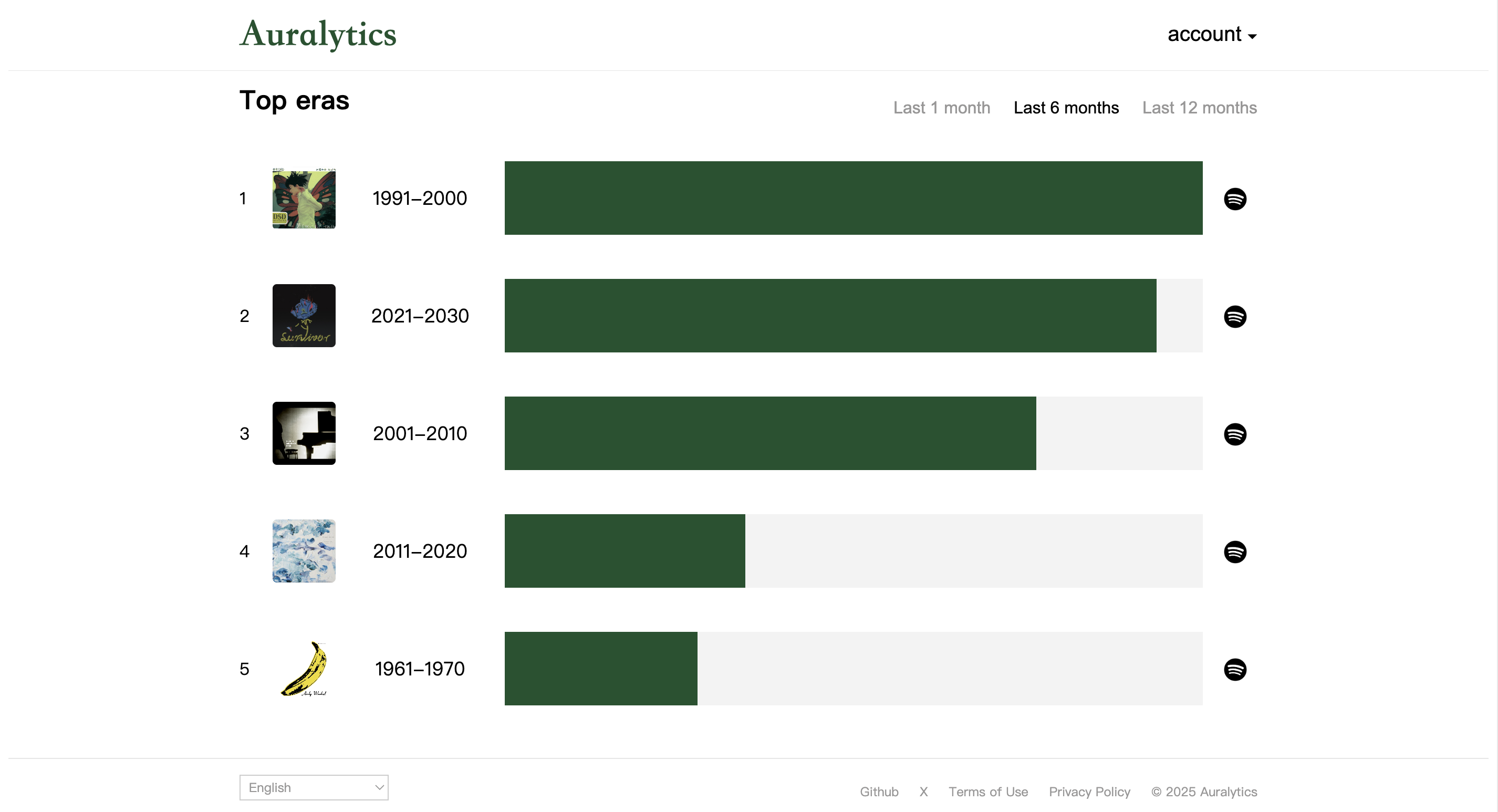
The interface emphasizes simplicity and coherence. Instant caching through Redis keeps interactions fluid, while real-time updates ensure that each new track listened to immediately reshapes the data portrait. Users can seamlessly navigate between insights without technical friction.
Auralytics also celebrates openness. An open-source local version allows developers and researchers to run the system independently, adapt visual layers, and experiment with new models of auditory analytics. This openness transforms Auralytics from a product into a shared platform for exploring how data, design, and identity converge.
Challenges
Spotify’s public API exposes only fragments of a user’s listening history, leaving vast regions of musical behavior unseen. This restriction became both a technical and conceptual challenge. Instead of accepting the gap, the system reimagined it as a creative space. Through a custom data augmentation process, incomplete information was expanded into richer temporal and relational patterns. The goal was not to predict what was missing but to reveal what could still be learned from what remained.
Processing tens of thousands of tracks per session required a balance between responsiveness and reliability. Redis caching and asynchronous data pipelines were optimized to preserve real-time interaction even under heavy load. Each refinement emerged from direct observation of bottlenecks, turning performance tuning into a form of iterative research. The result was a system that remained lightweight, interpretable, and fast, no matter how large the dataset became.
Impact
Auralytics transforms personal data into a medium for self-understanding and has demonstrated tangible impact within months of release. It reached more than 500 users worldwide, supporting ten languages to make reflection accessible across cultures. On Product Hunt, it ranked 54th among over 200 startups and was featured on theAwesome List, marking early recognition from both design and engineering communities.
The significance of outcomes lies not in scale alone but in perspective. Auralytics shows that analytics can serve reflection rather than prediction, that transparency can coexist with aesthetic clarity, and that understanding one’s data can be a form of authorship. As an open research platform, it continues to inform studies on personalization, emotional representation, and digital memory, extending a simple premise into a broader experiment on how humans learn through what they listen to.
Media